
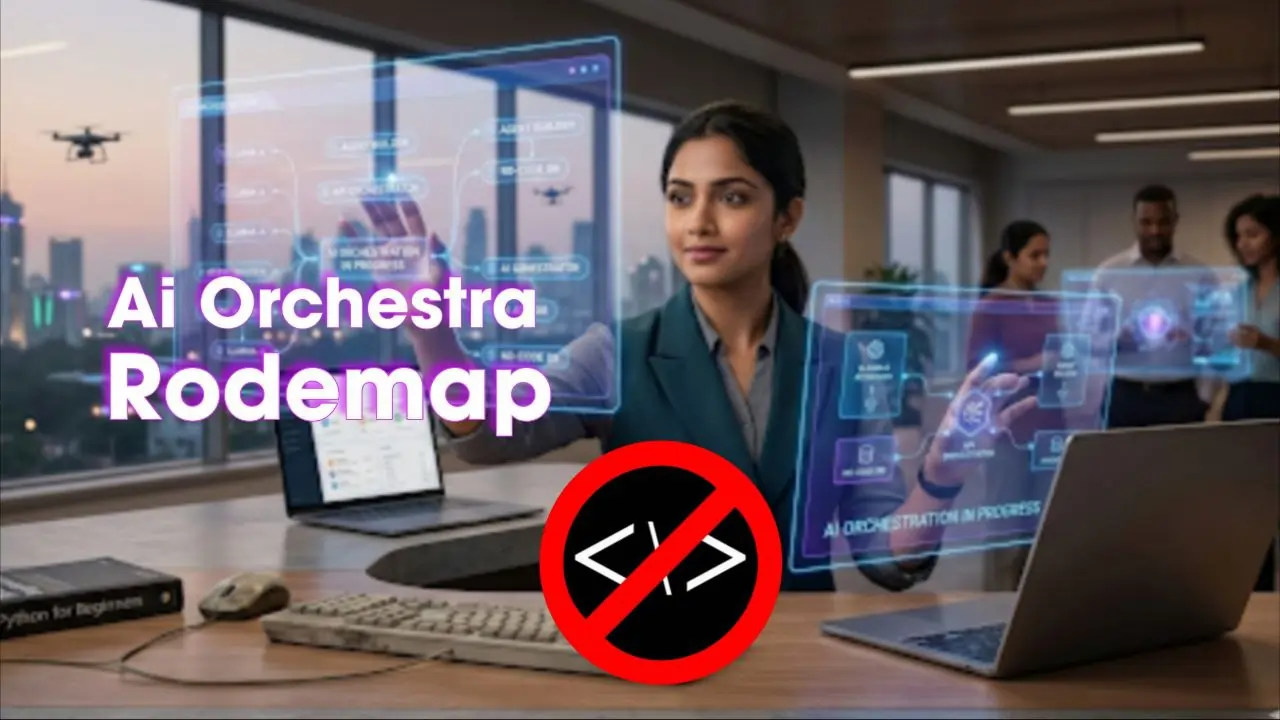
The era of the ‘Syntax Warrior’ is over. If you’re still grinding through hours of Python tutorials or memorizing semicolon rules in 2026, you’re building a career on shifting sands. AI doesn’t just write code anymore; it architects entire systems in seconds. But here’s the secret: the world doesn’t need more programmers it needs ‘Conductors.’ It needs people who can orchestrate dozens of AI agents to solve complex problems. This isn’t just a career shift; it’s a survival guide. Welcome to the world of AI Orchestration, where your logic matters more than your typing speed. Are you ready to lead?
Is Coding Dead in 2026? Stop Learning to Code; Master AI Orchestration Instead!
The tech world just hit a massive Refresh button. If you are still grinding away at syntax and semicolon placement in 2026, you might be practicing a dying art. The question isn’t whether coding is useful it’s whether traditional coding is still the fastest route to success.
The answer? Probably not. Welcome to the era of AI Orchestration.
The 2026 Reality: Syntax is Commodity, Logic is King
Two years ago, we were impressed that AI could write a Python script. Today, AI doesn’t just write scripts; it builds entire ecosystems, debugs in real-time, and deploys at scale.
The bottleneck is no longer How do I write this code? but “What should I build, and how do I connect the tools?” This shift has turned the traditional developer into a “Conductor” or an AI Orchestrator.
What is AI Orchestration? (And Why You Need It)
AI Orchestration is the ability to design, manage, and connect multiple AI models and automated workflows to solve a complex problem.
- Traditional Coder: Spends 4 hours writing a custom API integration.
- AI Orchestrator: Uses a “No-Code” or “Low-Code” platform to prompt an AI agent to build, test, and link that API to a database in 5 minutes.
In 2026, the industry values output and architecture over manual labor.
Why You Should Pivot Right Now
- Speed of Innovation: While someone is learning the basics of C++, an AI Orchestrator has already launched a Minimum Viable Product (MVP) using AI-driven builders like Cursor, Replit Agent, or Bolt.new.
- High-Value Problem Solving: Companies are desperate for people who understand business logic. They need people who can say, “I can use AI to automate our entire customer support and lead generation pipeline,” not just “I can fix a bug in your CSS.”
- The “Human-in-the-Loop” Premium: AI is powerful, but it’s prone to “hallucinations.” The human who knows how to audit, tweak, and supervise the AI (The Orchestrator) is the most protected employee in the room.
How to Become an AI Orchestrator in 2026
If you’re ready to stop memorizing documentation and start building, follow this roadmap:
- Master Prompt Engineering 2.0: Move beyond “Write me a poem.” Learn how to give AI structured data, system instructions, and multi-step reasoning tasks.
- Learn AI Agents: Understand how “Agents” (like AutoGPT or specialized custom GPTs) work together to finish a project without human intervention.
- Focus on System Design: Learn how a frontend, a backend, and a database connect. You don’t need to write the code for them, but you must understand the Map.
- Embrace Low-Code/No-Code: Tools like Zapier, Make.com, and Framer are the new power tools of 2026.
The 2026 AI Orchestrator Roadmap

The Verdict: Is Coding Truly Dead?
Coding isn’t “dead,” but it has become a specialized niche. Think of it like a clockmaker. People still make mechanical watches by hand, and they are beautiful and expensive—but most of the world runs on digital precision.
If you want to be a hobbyist, learn to code. But if you want to lead the tech industry in 2026, learn to orchestrate. Visit our 50 free ai courses list 2026
I am Md Amon Sk, a Website Developer with 2 years of experience. As part of the Choosfy Team, I focus on building quality websites and sharing the latest insights on AI tools.
1 thought on “Is Coding Dead in 2026? Stop Learning to Code; Master AI Orchestration Instead!”
Comments are closed.