

How to Start AI Trading in India 2026 Full Guide Step By Step
Artificial Intelligence is no longer a futuristic concept reserved for large hedge funds and global investment banks. In 2026, AI trading has become increasingly accessible to retail traders in India. With broker APIs, algorithmic platforms, and machine learning tools now widely available, individual investors can deploy automated strategies that analyze market data, manage risk, and execute trades with precision.
However, starting AI trading in India is not as simple as installing a trading bot and expecting instant profits. It requires a clear understanding of how AI-based systems work, the regulatory framework governing algorithmic trading, the capital required, and the risks involved. While AI trading offers speed, consistency, and data-driven decision-making, it does not eliminate market uncertainty.
For Indian traders, the opportunity lies in combining technological efficiency with disciplined strategy. From equity markets and derivatives to emerging digital asset platforms, AI tools are reshaping how trades are executed. At the same time, compliance with SEBI regulations and broker guidelines remains essential to ensure legal and secure participation.
This complete 2026 guide will walk you through everything you need to know before starting AI trading in India. You will learn what AI trading actually means, how these systems operate, which platforms are suitable, how much capital is required, and what common mistakes beginners should avoid. Whether you are a new trader exploring automation or an experienced participant looking to optimize performance, this guide provides a structured roadmap to help you begin responsibly and strategically. AI Trading vs Manual Trading: Which Is Better for Indian Traders in 2026?
How to Start AI Trading in India 2026
Artificial Intelligence is quietly reshaping financial markets across the world. What was once the exclusive domain of large hedge funds and institutional investors is now increasingly accessible to retail traders in India. Algorithmic systems powered by machine learning are analyzing market patterns, processing news sentiment, and executing trades faster than any human possibly could.
But accessibility does not mean simplicity.
Starting AI trading in India requires more than installing a trading bot. It demands an understanding of market mechanics, regulatory structure, risk management, capital allocation, and the strengths and limitations of artificial intelligence itself.
This guide is designed to give you a complete and realistic roadmap. Whether you are a beginner curious about AI-based trading strategies or an intermediate trader exploring automation, this pillar article will help you understand how AI trading works, how to start legally in India, what capital you need, and what mistakes to avoid.
This comprehensive pillar guide will help you understand:
- What AI trading actually means
- How AI-based strategies work
- The evolution of algorithmic trading
- Real success stories from India and around the world
- Legal framework in India
- Best platforms to start
- Risks, capital requirements, and beginner mistakes
- The future of AI trading in India
What is AI Trading?
AI trading refers to the use of artificial intelligence and machine learning algorithms to analyze financial market data and execute trades automatically or semi-automatically. Unlike traditional trading, where a human trader manually studies charts and makes decisions based on experience and emotion, AI trading systems rely on data models and statistical probabilities.
At its core, AI trading is an advanced evolution of algorithmic trading. Traditional algorithmic systems follow fixed rules. For example, if a stock crosses a certain moving average, a buy signal is triggered. However, AI-driven systems go much deeper. They are capable of identifying complex relationships between variables that may not be visible to the human eye.
These systems can analyze historical price movements, volatility cycles, macroeconomic indicators, order book depth, and even sentiment derived from news headlines. The goal is not to predict the future with certainty but to calculate probabilities with greater efficiency.
It is important to understand that AI trading is not a shortcut to guaranteed profits. It is a tool designed to improve consistency and reduce emotional bias. The intelligence comes from mathematics and data processing power, not from intuition.
Unlike traditional trading where humans:
- Read charts
- Apply indicators
- Make emotional decisions
AI systems:
- Process millions of data points instantly
- Detect complex patterns
- Generate probability-based predictions
- Execute trades automatically
AI trading is an advanced form of algorithmic trading, where systems adapt and improve over time.
It is widely used in:
- Stock markets
- Options and derivatives
- Forex markets
- Cryptocurrency trading
The primary goal is to increase efficiency while reducing emotional bias.
How AI Trading Works in Practical Terms
To understand how to start AI trading in India, you must first understand how these systems function in real market conditions.
The process begins with data collection. Financial markets generate enormous volumes of data every second. This includes price changes, trade volumes, liquidity information, derivatives positions, and macroeconomic announcements. AI systems gather this structured and unstructured data to create a foundation for analysis.
The second stage involves model development. Machine learning algorithms are trained using historical data. During this phase, the system identifies patterns that historically led to certain outcomes. For instance, it may discover that during specific volatility conditions combined with rising volumes, certain price behaviors repeat with measurable probability.
Once a strategy is developed, it undergoes backtesting. Backtesting involves running the strategy against historical data to evaluate its performance under past market conditions. This helps measure risk, drawdowns, and potential returns. However, experienced traders understand that backtesting results must be interpreted cautiously, as past performance does not guarantee future outcomes.
After testing, the strategy is deployed live through broker APIs. In India, many brokers provide API access that allows automated execution. The system then monitors market conditions in real time and executes trades according to predefined parameters.
More advanced AI models continuously learn from new data, adjusting their internal parameters as market dynamics shift. This adaptive capability is what differentiates AI-based trading from older rule-based systems.

The Evolution of Algorithmic Trading with AI
Algorithmic trading in India began gaining traction after the widespread adoption of electronic trading systems. Initially, these were simple rule-based systems used primarily by institutions.
As computational power improved, quantitative trading strategies emerged. These relied heavily on mathematical models and statistical arbitrage techniques. However, they still required manual optimization and periodic adjustments.
The introduction of machine learning transformed this landscape. AI models allowed systems to detect subtle correlations across thousands of variables simultaneously. Hedge funds globally began integrating predictive analytics and pattern recognition into their trading infrastructure.
In India, the growth of fintech infrastructure and broker APIs has democratized access. Retail traders now have tools that were once exclusive to large investment firms. This evolution represents not just technological advancement but a structural shift in how trading decisions are made.
Advantages and Challenges of AI-Based Strategies
AI trading offers compelling advantages. One of the most significant benefits is emotional neutrality. Markets are heavily influenced by human psychology. Fear during crashes and greed during rallies often lead to irrational decisions. AI systems operate without emotional bias, strictly following probability-based logic.
Another advantage is speed. In volatile markets, milliseconds can determine profitability. AI systems execute trades far faster than manual traders, especially in derivatives or high-frequency environments.
Scalability is also important. A human trader can realistically monitor only a limited number of instruments. AI systems can simultaneously track hundreds of assets across different markets.
However, these advantages come with challenges. One major risk is overfitting, where a model performs exceptionally well during backtesting but fails in live conditions because it was optimized too closely to historical data.
Market regime changes also pose risks. Sudden geopolitical events or economic shocks can disrupt established patterns. AI models trained on stable conditions may struggle during unprecedented volatility.
Technical infrastructure is another factor. Server downtime, API errors, or latency issues can result in financial losses. Moreover, regulatory compliance must always be maintained.
AI trading enhances decision-making efficiency, but it does not eliminate market risk.
Case Studies: AI Success Stories (India and Global)
Real-world examples show how AI is changing the game:
Fraud Detection: Leading banks like ICICI use AI to flag “circular trading” (where groups of people trade among themselves to fake volume), keeping the market cleaner for retail investors.
Institutional Giants: The National Stock Exchange (NSE) now uses AI to detect insider trading patterns, identifying suspicious spikes before they become news.
Retail Success: Professional traders in Mumbai have reported reducing their “drawdown” (peak-to-trough decline) by 15% after switching from manual execution to AI-assisted risk management tools.
Is AI Trading Legal in India?

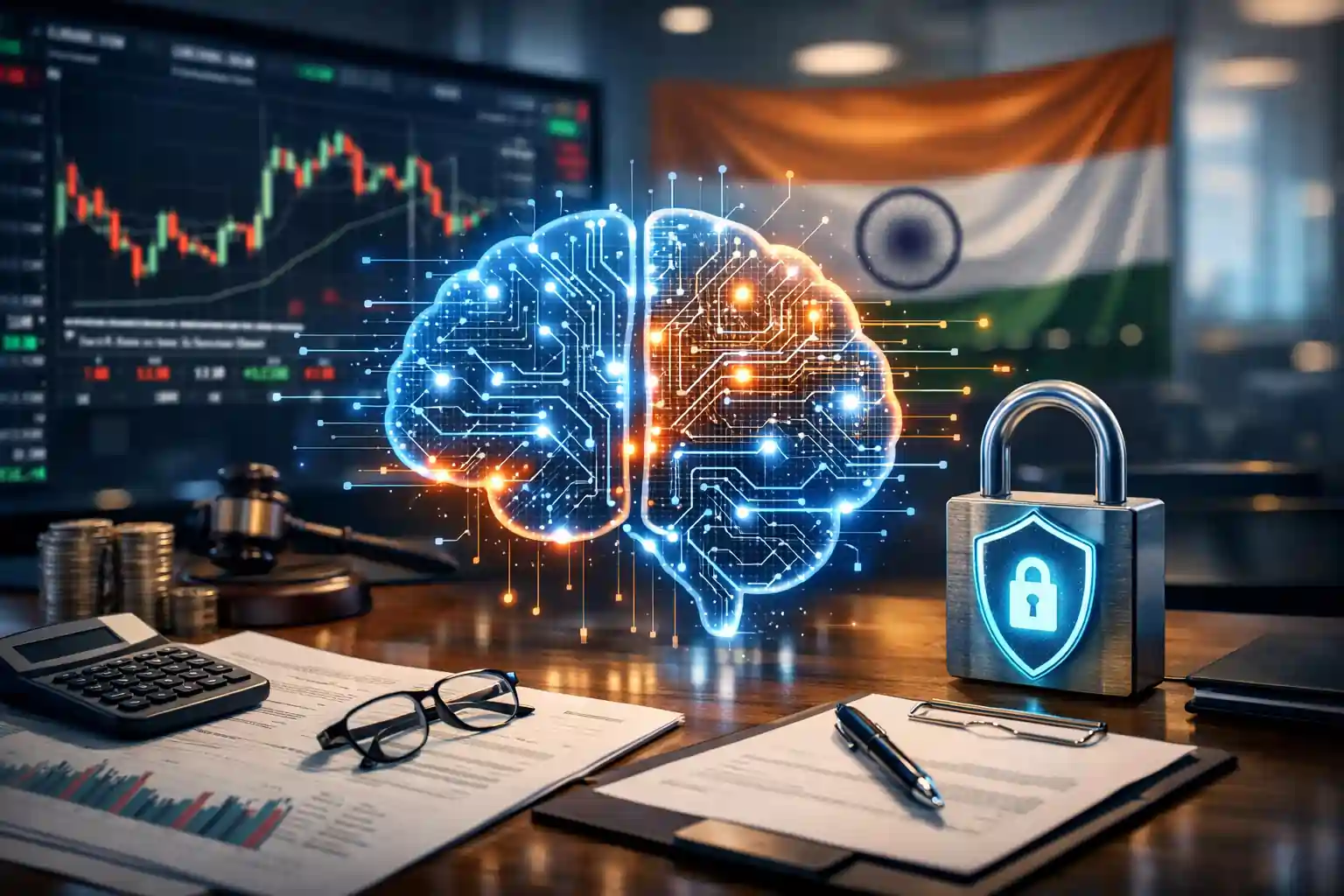
AI trading is legal in India, but it must comply with regulations set by the Securities and Exchange Board of India.
Retail traders can use automated strategies if they operate through SEBI-registered brokers and follow API guidelines. Unauthorized algorithm deployment or manipulative strategies can lead to penalties.
Compliance includes maintaining transparent records, adhering to exchange norms, and avoiding unfair trading practices. The legal framework supports innovation but enforces strict oversight.
AI Trading Rules and Regulations in India
- AI trading must comply with regulations set by the Securities and Exchange Board of India (SEBI).
- Automated trading systems must operate through SEBI-registered brokers only.
- Direct access to stock exchanges without broker authorization is not permitted for retail traders.
- All automated strategies must follow broker API guidelines and exchange risk management systems.
- Traders must adhere to margin requirements, position limits, and circuit breaker rules set by exchanges.
- Market manipulation practices such as spoofing, artificial volume creation, or price rigging are strictly prohibited.
- Platforms promising guaranteed returns or fixed profits may violate Indian financial regulations.
- Proper record-keeping, audit trails, and tax compliance are mandatory for all trading activities.
- Traders are responsible for ensuring that the AI tools they use are legally integrated with licensed brokers.
- And follow The Reserve Bank of India (RBI) rule
Choosing Your Platform and Placing Your First AI Trade
Starting is simpler than it used to be. Here is the 4-step process:
- Open a Demat Account: You need a broker that supports API access (e.g., Zerodha, Angel One, or Upstox).
- Select an AI Bridge: Choose a platform that connects your AI logic to your broker.
- Code or No-Code: Use Python for custom builds or “no-code” platforms like Streak or Tradetron to build strategies visually.
- Paper Trade First: Never go “live” immediately. Use virtual money to see how the AI handles real market volatility for at least two weeks.
Best AI Trading Apps in India (2026)
| App / Platform | Best For | Key Feature | Official Link |
|---|---|---|---|
| Tradetron | Strategy Marketplace | Huge library of pre-made AI strategies. | Visit Tradetron |
| Streak (Zerodha) | Beginners | No-code interface for technical patterns. | Visit Streak |
| AlgoTest | Options Traders | Exceptional backtesting for Nifty/BankNifty. | Visit AlgoTest |
| Kuvera | Long-term Investors | AI-driven “Goal-based” mutual fund investing. | Visit Kuvera |
| Tickeron | Technical Analysis | AI pattern recognition scanner for stocks. | Visit Tickeron |
Minimum Capital Needed
While there is no legal minimum for your trading account, here is the practical reality in 2026:
Note: Recent SEBI relaxations for “Accredited Investors” have lowered the entry for AI-managed PMS (Portfolio Management Services) from ₹50 lakh to roughly ₹10–25 lakh for those with the right license.
For Testing/Learning: ₹10,000 – ₹25,000.
For Meaningful Returns (Intraday/Options): ₹1,00,000 – ₹5,00,000.
Risks & Reality
Let’s have a “coffee chat” moment: AI is not a money-printing machine. * Market Risk: If the entire market crashes (e.g., a global black swan event), your AI will likely lose money along with everyone else.
- Curve Fitting: A strategy that worked perfectly on “past” data might fail on “future” data because the market “regime” has changed.
- Cost: Quality AI tools often come with subscription fees that can eat into the profits of small accounts.
Common Beginner Mistakes
Many beginners approach AI trading with unrealistic expectations. They purchase expensive bots without understanding the underlying strategy. They rely heavily on backtest results without forward testing. They increase position sizes too quickly after short winning streaks.
The most dangerous mistake is assuming automation eliminates risk. AI reduces emotional error but does not remove market uncertainty.
Education, patience, and disciplined risk management remain essential.
Future Outlook: The Next Wave of AI Trading in India

India’s financial ecosystem is evolving rapidly. Increased fintech adoption, improved computational infrastructure, and growing retail participation are driving algorithmic growth.
Future developments may include more advanced AI-driven portfolio management tools, real-time sentiment analysis integration, and stronger regulatory frameworks for retail automation.
As artificial intelligence continues to mature, its role in Indian markets will likely expand. However, successful adoption will depend on informed participation rather than blind enthusiasm.
Conclusion
AI trading in India represents a powerful technological shift. It offers speed, analytical depth, and emotional discipline. Yet it demands understanding, compliance, and risk awareness.
If you approach AI trading with patience and structured learning, it can become a valuable component of your financial strategy. But like any market activity, it rewards preparation more than shortcuts.
FAQs
Is AI trading better than manual trading?
t is more consistent, but a skilled human trader can sometimes spot “context” (like a political shift) better than a machine.
Is AI trading profitable?
It can be, but success depends on strategy quality and risk management.
Is AI trading legal in India?
Yes, if conducted through SEBI-compliant brokers.
How much capital is safe to start ai trading?
Start small — ideally money you can afford to lose.

I am Md Amon Sk, a Website Developer with 2 years of experience. As part of the Choosfy Team, I focus on building quality websites and sharing the latest insights on AI tools.
4 thoughts on “How to Start AI Trading in India 2026 You Need To Pro Trader”
Comments are closed.