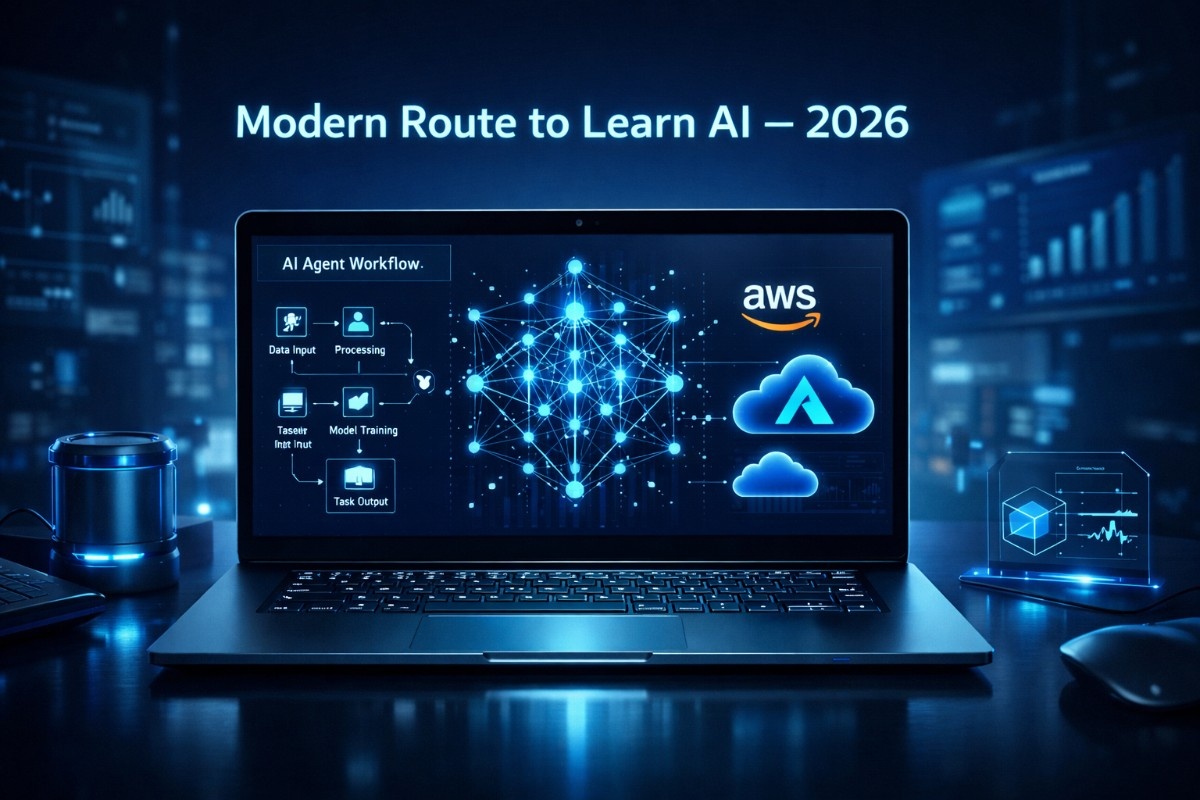
How to Learn AI Using Modern Routine in 2026 (Step-by-Step Roadmap for 1 Year)
Artificial Intelligence in 2026 is not about memorizing algorithms anymore. It is about building real-world systems using Generative AI, LLMs, and AI agents. If you already know Python and have basic technical knowledge, you do not need to follow the old data science-heavy route. Instead, you can follow a modern routine designed for industry professionals who want fast, practical results.
Below is a structured 1-year roadmap divided into clear phases.
Phase 1 (Month 1–3): Build Strong Generative AI Foundations
Your first 90 days should focus on understanding how modern AI systems actually work.
What to Learn
• Python mastery (if not already strong)
• APIs and REST fundamentals
• Basics of Machine Learning & Deep Learning
• Transformer architecture
• Tokenization and embeddings
• How LLMs work
• Prompt engineering basics
What to Practice
Instead of only watching tutorials, start building small projects:
• Chatbot using OpenAI or similar APIs
• Document summarizer
• Blog generator
• FAQ bot using embeddings
Daily Routine (2–3 Hours)
1 hour theory (LLM, transformers, embeddings)
1 hour hands-on coding
30–45 minutes reading documentation
By the end of 3 months, you should understand how to call LLM APIs, manage tokens, control outputs, and structure prompts properly.
Goal: Build 3–5 mini GenAI projects.
Phase 2 (Month 3–6): Master LLM Applications & RAG Systems
Now you move from “using AI” to “engineering AI systems.”
What to Learn
• Advanced Prompt Engineering
• Retrieval-Augmented Generation (RAG)
• Vector databases (FAISS, Pinecone, etc.)
• Fine-tuning basics
• LLM hosting fundamentals
• LangChain basics
• API integrations
What to Build
• PDF Question Answering system
• Resume analyzer
• Custom chatbot trained on company data
• AI-powered search system
You should now understand how to connect LLMs with external data sources.
Weekly Routine
2 days learning new concepts
3 days project building
1 day debugging + optimization
1 day documentation writing
Goal: Build at least 2 production-style RAG systems.
Phase 3 (Month 6–9): Learn Agentic AI & Workflow Automation
This is where you become industry-ready.
AI agents are not just chatbots. They reason, plan, execute tools, and automate workflows.
What to Learn
• AI agents architecture
• Multi-agent systems
• LangChain advanced
• LangGraph
• Tool calling
• Memory systems
• Guardrails & evaluation
• Cloud API integration
What to Build
• AI agent that automates email workflows
• Multi-agent research assistant
• AI-powered data analysis agent
• Automated content publishing pipeline
At this stage, your projects should solve real business problems.
Goal: Build at least 2 agent-based automation systems.

Phase 4 (Month 9–12): Production Deployment & Cloud Scaling
Now you transition from developer to AI engineer.
What to Learn
• AWS or Azure fundamentals
• Model deployment
• Docker basics
• API hosting
• Monitoring & logging
• Security best practices
• Cost optimization
What to Build
• Deploy your AI agent to cloud
• Build a SaaS-style AI tool
• Add authentication
• Add monitoring dashboard
Now you are no longer experimenting — you are building deployable AI products.
Goal: Have 1 fully deployed production-grade AI system.
After 1 Year: Where You Should Be
If you follow this routine seriously:
• You will understand Generative AI deeply
• You will build AI agents from scratch
• You will deploy scalable AI systems
• You will be job-ready for GenAI/Agentic AI roles
• You can start freelancing or building your own AI SaaS
This modern routine avoids wasting time on unnecessary theoretical overload. It focuses on practical, in-demand AI skills.
Weekly Smart Routine (Long-Term Discipline Plan)
Monday–Friday:
2–3 hours daily coding + learning
Saturday:
Project building (4–5 hours)
Sunday:
Debugging, deployment practice, research
Consistency matters more than intensity.
AI Learning Modern Routine (1 Year Roadmap)
| Timeline | Focus Area | Skills to Learn | Projects to Build |
|---|---|---|---|
| Month 1–3 | Generative AI Foundations |
Python Mastery Transformer Basics LLM APIs Embeddings Prompt Engineering |
AI Chatbot Blog Generator Document Summarizer |
| Month 3–6 | LLM Engineering & RAG |
Advanced Prompting RAG Systems Vector Databases Fine-Tuning Basics LangChain |
PDF QA System Resume Analyzer AI Knowledge Bot |
| Month 6–9 | Agentic AI Development |
AI Agents Architecture Multi-Agent Systems LangGraph Tool Calling Memory Systems |
Email Automation Agent Research Agent Workflow Automation System |
| Month 9–12 | Deployment & Cloud Scaling |
AWS / Azure Basics Docker API Hosting Monitoring & Security |
Deploy AI Agent to Cloud SaaS AI Tool Production Dashboard |
Key Principles of Modern AI Learning
- Build more than you consume.
- Focus on GenAI + Agents early.
- Learn cloud deployment before month 12.
- Study real industry use cases.
- Do not chase every new tool — master fundamentals.
What You Will Learn After 1 Year (Modern AI Routine)
If you consistently follow the 1-year modern AI learning roadmap, here’s what you’ll realistically achieve:
1. Strong Generative AI Foundation
You’ll deeply understand transformers, embeddings, tokenization, LLM behavior, and advanced prompt engineering. You won’t just call APIs — you’ll understand how they work.
2. Build RAG Systems
You’ll be able to create AI systems connected to custom data using vector databases. This includes PDF question-answering bots and enterprise knowledge assistants.
3. Develop AI Agents
You’ll know how to build single and multi-agent systems that can reason, plan, call tools, and automate workflows.
4. Full Stack AI Applications
You’ll be able to integrate backend APIs, connect frontends, and build real AI-powered SaaS-style tools.
5. Deploy to Cloud
You’ll understand AWS or Azure basics, API hosting, Docker fundamentals, and production deployment.
6. Industry-Ready Portfolio
You’ll have 5–8 solid AI projects, including at least one production-grade deployed system.

Final Advice
The AI industry is shifting rapidly toward agentic systems and production-grade generative applications. Companies are not looking for theory-heavy ML engineers alone. They want professionals who can build, deploy, and scale AI systems.
If you commit to this 1-year structured roadmap, you will not just “learn AI.” You will become capable of building AI systems that solve real-world problems.
The modern routine is about speed, clarity, and industry alignment.
I am Md Amon Sk, a Website Developer with 2 years of experience. As part of the Choosfy Team, I focus on building quality websites and sharing the latest insights on AI tools.
8 thoughts on “How to Learn AI Using Modern Routine in 2026 – Full Stack Generative & Agentic AI Guide”
Comments are closed.