
Artificial Intelligence is growing very fast in 2026. From writing blogs to generating videos, creating designs, coding software, and automating business tasks — AI tools are everywhere. Many companies are making billions of dollars using AI. But most people only see the success stories. Very few talk about the dark side of AI monetization.
Before understanding the risks, let’s first understand something simple.
What Is AI Monetization? (In Simple Words)
AI monetization means earning money from AI tools or AI technology.
Companies build AI products — like writing tools, image generators, coding assistants, or automation software — and then charge users for access. This can happen in different ways:
• Monthly subscriptions
• Yearly business plans
• Pay-per-use API billing
• Enterprise licensing
• Feature upgrades (premium plans)
For example, if someone pays $20 per month to use an AI writing tool, that is AI monetization. If a company uses an AI API and pays based on usage, that is also monetization.
In short: AI tool → Users pay → Company earns revenue.
Simple.
How Do AI Companies Make Money?
AI companies usually earn money through structured business models. Here are the most common ones:
1. Subscription Model
Users pay monthly or yearly to use AI features. This is the most popular model in 2026.
2. Freemium Model
Basic features are free. Advanced features require payment. This attracts users first, then converts them to paid plans.
3. API Usage Pricing
Developers pay based on how many requests or tokens they use.
4. Enterprise Contracts
Big companies pay large yearly amounts for AI integration into internal systems.
5. Data & Optimization Value
Even when tools are free, usage data helps improve models, which increases long-term commercial value.
AI monetization has become one of the biggest digital business opportunities in the world.
When AI Is Monetized, What Actually Happens?
When AI tools are monetized:
• Companies earn revenue
• Investors see profit potential
• More funding goes into AI development
• New tools are launched
• Competition increases
Yes, monetization leads to income. In fact, some AI platforms now generate billions in annual revenue.
But monetization also changes priorities.
When money becomes the main focus, product decisions are influenced by revenue targets. This is where the dark side begins.
The AI Subscription Economy Trap
Most AI tools operate on subscription models. At first, prices look small — $10, $20, or $30 per month.
But think realistically.
A creator may use:
• AI writing tool
• AI image generator
• AI video editor
• AI automation platform
• AI coding assistant
Now multiply those subscriptions.
Individually affordable. Collectively expensive.
This is one of the biggest AI monetization risks — growing digital dependency with recurring financial pressure.
LLM Training Costs Create Monetization Pressure
Training large AI models is extremely expensive. LLM training costs can reach hundreds of millions or even billions of dollars.
Because of this:
• Companies must recover investment
• Pricing becomes aggressive
• Premium tiers expand
• API billing increases
Profit is necessary, but when AI profit vs ethics becomes unbalanced, users feel the impact.
Data: The Hidden Currency
Many people believe they only pay money. But data is also valuable.
AI systems learn from usage patterns. Prompts, corrections, behavior — all improve the system.
This raises AI data privacy concerns:
• How is user data stored?
• Is it used for model training?
• Is enterprise data fully secure?
Monetization at scale often requires massive data flow.
Transparency is not always clear.
Content Saturation Problem
AI makes content production extremely easy.
Blogs. Videos. Social posts. Ads.
But when everyone uses the same AI tools, originality drops. The internet becomes crowded with similar content.
Over time:
• Trust decreases
• Quality becomes harder to measure
• Human creativity weakens
From my personal experience as Md Amon Sk, AI works best when guided by human thinking. Automation alone creates volume, not authority.
Overdependence Risk
Businesses now depend heavily on AI for:
• Customer service
• Coding
• Marketing campaigns
• Financial forecasting
If pricing changes or access is restricted, operations can be disrupted.
This platform dependency is a serious AI business model problem.
When monetization decisions change, users lose control.
Ethical Questions Around AI Revenue
The ethical issues in AI revenue are rarely discussed openly.
Important questions include:
• Should powerful AI tools be accessible only to paying users?
• Should monetization limit innovation?
• Should companies prioritize shareholders over transparency?
AI monetization risks are not about stopping AI.
They are about building responsible systems.
Enterprise AI and Job Impact
Some companies adopt AI primarily to reduce costs.
While automation increases efficiency, it can also lead to:
• Workforce reduction
• Reduced creative roles
• Heavy algorithmic decision-making
Profit-driven AI deployment without human balance can create long-term instability.
The Illusion of “Free” AI
Many tools claim to be free.
But free often means:
• Limited tokens
• Watermarks
• Export restrictions
• Upsell pressure
Free is often the first step in a long subscription funnel.
This is not wrong — but users should understand the full cost cycle.
What Responsible AI Monetization Should Look Like
Healthy AI monetization should include:
• Transparent pricing
• Clear data policies
• Ethical AI training
• Human oversight
• Fair access models
The future of AI depends on balance.
AI monetization is not the enemy. But blind monetization is risky.
Conclusion
AI monetization has created one of the largest digital economies in history. Companies earn billions, investors gain confidence, and innovation accelerates.
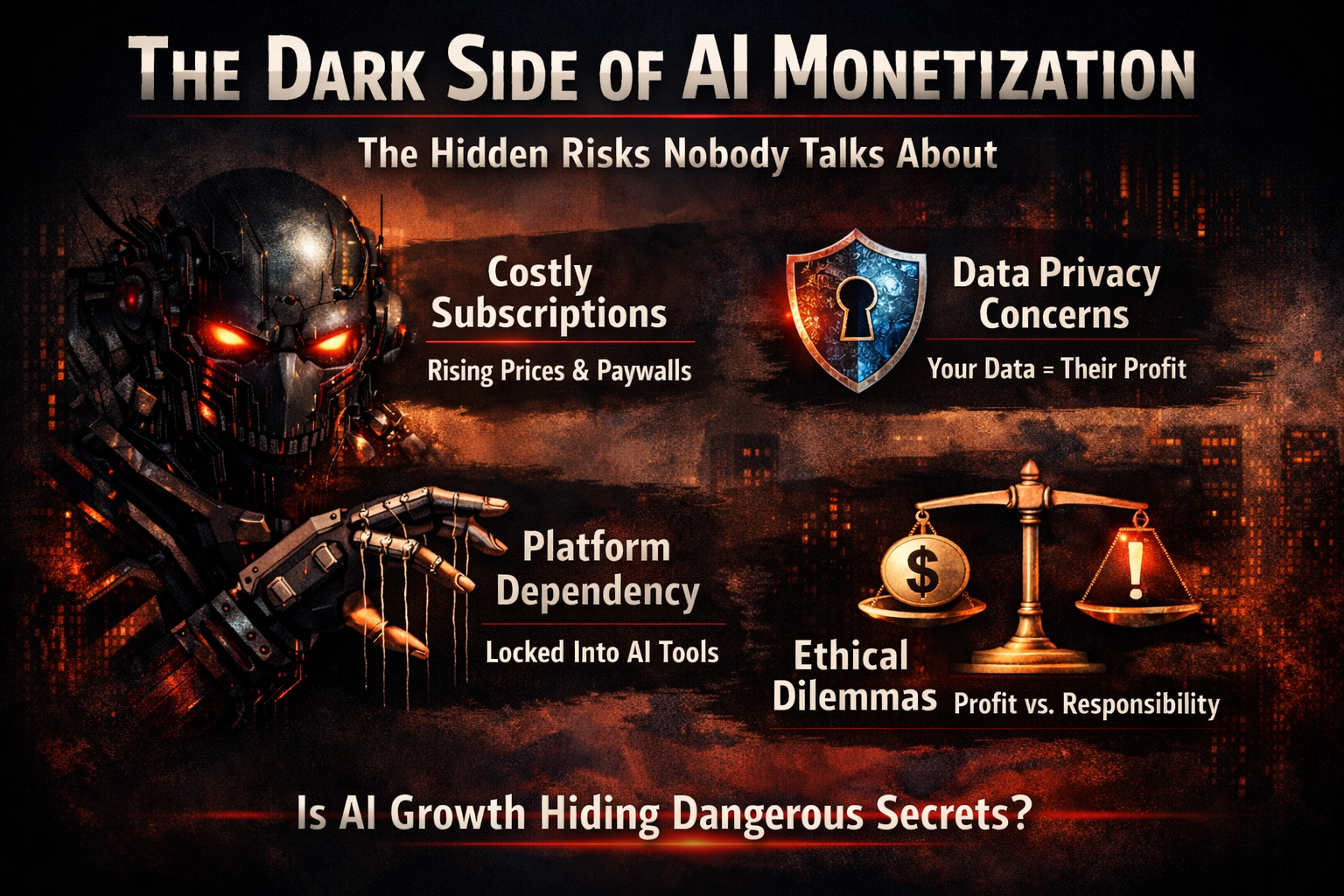
But the dark side of AI monetization nobody talks about includes rising subscription costs, data privacy risks, overdependence, and ethical concerns.
AI should empower humans — not replace responsibility.
The real future of AI will not be decided only by intelligence or profit.
It will be decided by transparency, ethics, and balance.
FAQs
What is AI monetization?
AI monetization refers to earning revenue from AI tools through subscriptions, API billing, enterprise contracts, or premium feature upgrades.
What are the risks of AI monetization?
AI monetization risks include rising subscription costs, data privacy concerns, overdependence on platforms, and ethical business model issues.
Why are AI subscriptions becoming expensive?
High LLM training costs and infrastructure expenses push companies to adopt aggressive pricing models.
How can users avoid AI overdependence?
Users should diversify tools, maintain human oversight, and avoid building critical workflows around a single AI platform.

I am Md Amon Sk, a Website Developer with 2 years of experience. As part of the Choosfy Team, I focus on building quality websites and sharing the latest insights on AI tools.
2 thoughts on “The Dark Side of AI Monetization Nobody Talks About 2026”
Comments are closed.