
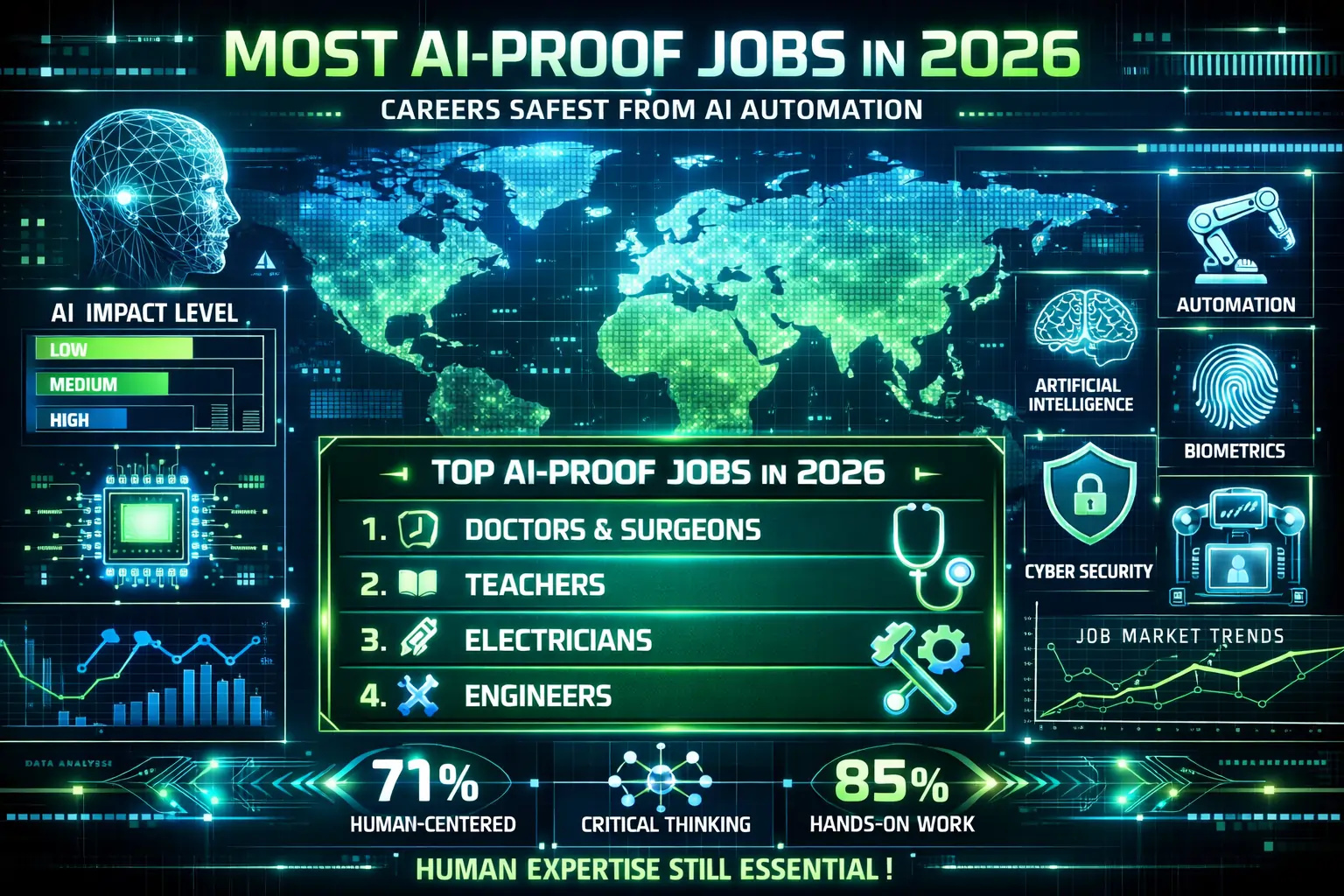
Overview AI-Proof Jobs
Table of Contents
Artificial intelligence is rapidly changing the job market in 2026. Many companies now use AI tools to automate routine tasks, which makes some traditional jobs less secure. Because of this, many students and professionals are searching for Most AI-proof jobs 2026 to understand which careers are safe in the future.
The good news is that not every job can be replaced by machines. Careers that require human creativity, empathy, leadership, and physical skills remain difficult for AI to automate. These roles are often called Jobs that AI cannot replace.
In this article, we will explore the Most AI-proof jobs 2026, explain why they are secure, and help students discover Future-proof careers for students in the AI era.
Key Takeaways: Most AI-Proof Jobs 2026
- In 2025, around 85 million jobs worldwide were affected or replaced by AI automation, according to global workforce reports.
- Experts estimate that by 2026, more than 100 million jobs may be partially automated, especially in routine office roles.
- One of the Most AI-proof jobs 2026 is Mental Health Counselor, because it requires empathy and human emotional understanding.
- One of the highest-risk jobs for AI automation is Data Entry Clerk, since most of its tasks can be completed by software and AI systems.
AI Job Market Statistics (2025–2026)
Artificial intelligence is rapidly changing the global workforce. Reports show that millions of jobs are being automated every year. Understanding these trends helps explain why people are searching for Most AI-proof jobs 2026.
In 2025 alone, more than 83 million jobs were affected by automation. Experts estimate that by 2026 over 100 million jobs may be partially automated. This is why many professionals are focusing on Jobs that AI cannot replace and exploring Future-proof careers for students.
Why AI-Proof Jobs Matter in 2026
Artificial intelligence is transforming the global workforce faster than ever before. Many companies are using AI tools to automate routine tasks such as data entry, customer support, and basic content creation. Because of this shift, many workers now feel a growing concern known as “AI Anxiety.” People worry that machines might eventually replace their jobs.
However, not every profession faces the same risk. Some careers are much harder for machines to replace. When we talk about Most AI-proof jobs 2026, we are referring to roles that depend heavily on human judgment, physical presence, and emotional intelligence. These are areas where AI still struggles to perform effectively.
Experts studying Jobs that AI cannot replace often highlight jobs that involve real-world problem solving. Machines can process data extremely well, but they cannot easily navigate unpredictable environments or understand complex human emotions. This is why hands-on careers and people-focused professions continue to remain stable.
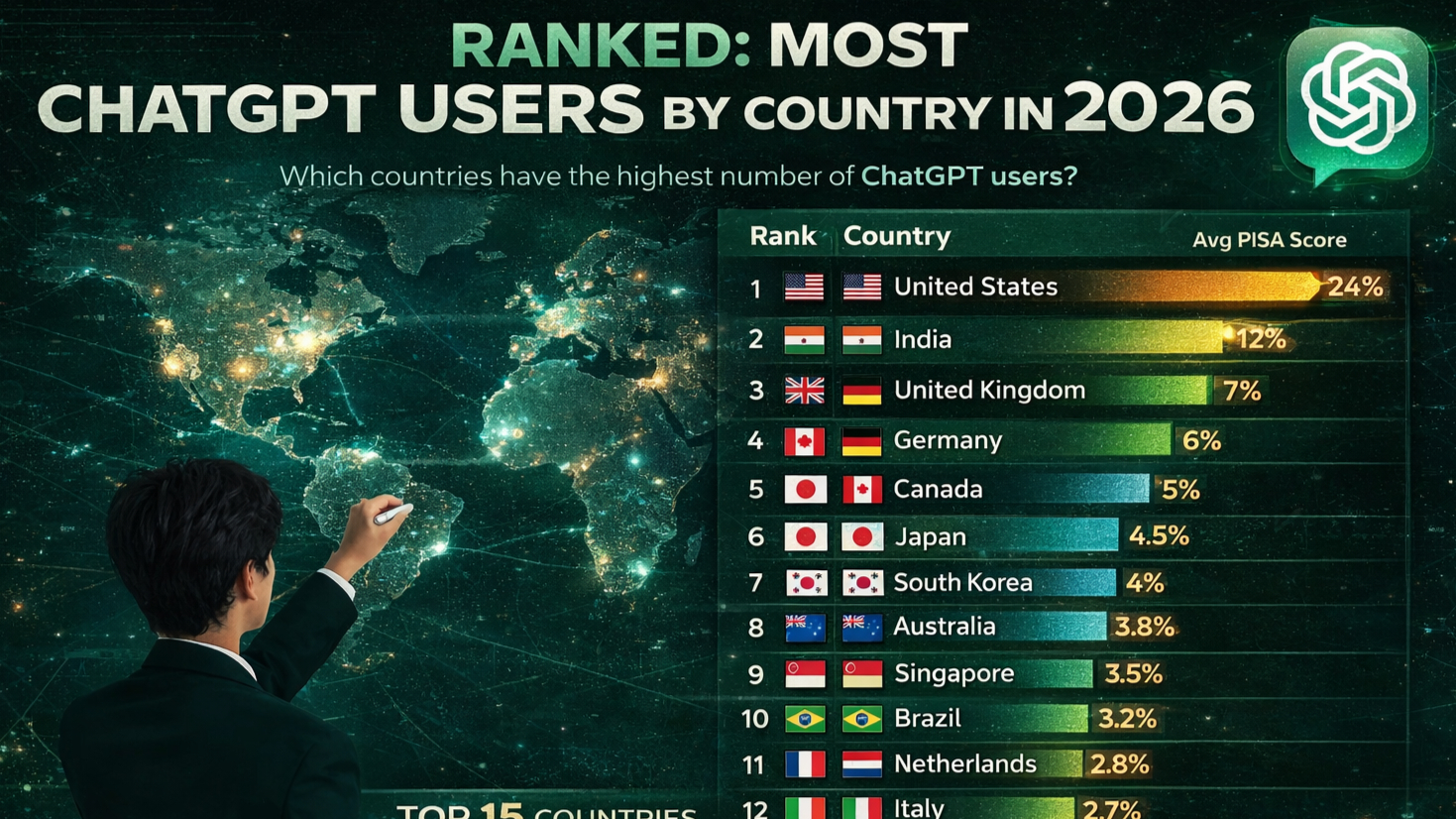
Another reason Most AI-proof jobs 2026 are important is that students are now planning their careers differently. Instead of choosing jobs based only on salary, many are focusing on Future-proof careers for students. They want roles that will remain relevant even as technology evolves.
In simple terms, the safest jobs in the future will be the ones where human skills are essential. Professions that require empathy, creativity, leadership, and physical work are much harder for machines to replace.
The Jobs at the Top – Machines Can’t Touch, Detailed Analysis
When researchers analyze Most AI-proof jobs 2026, a few categories consistently appear at the top of the list. These include skilled trades, mental health services, and specialized healthcare professions. Each of these roles requires abilities that machines simply cannot replicate.
Skilled Trades: Plumbers and Electricians
Skilled trade jobs are among the Most AI-proof jobs 2026 because they involve working in unpredictable physical environments. A plumber or electrician often deals with complex systems inside buildings, where every situation is slightly different. AI systems and robots still struggle to adapt to these constantly changing real-world conditions.
For example, repairing a leaking pipe may require analyzing the building structure, adjusting tools, and responding to unexpected problems. These tasks require experience, quick decision-making, and hands-on skills. Because of this complexity, Jobs that AI cannot replace often include technical trade work.
Most electricians and plumbers gain their skills through vocational training or apprenticeships. Many countries also require professional licenses to ensure safety standards are met. While the training process can take several years, it leads to stable career opportunities.
In terms of income, these professions offer strong earning potential. In the United States and many developed countries, experienced plumbers and electricians can earn between $60,000 and $95,000 per year. As demand for skilled workers increases, these salaries may continue to rise.
Mental Health Counselors
Another category within Most AI-proof jobs 2026 is mental health counseling. While AI can analyze data and provide basic suggestions, it cannot truly understand human emotions or personal trauma. Effective therapy requires deep empathy, emotional awareness, and trust between the counselor and the patient.
Mental health professionals help people manage stress, anxiety, depression, and other psychological challenges. These conversations often involve sensitive life experiences that require careful listening and emotional support. Machines cannot replicate this level of human connection.
As societies become more aware of mental health issues, the demand for counselors continues to grow. This makes mental health services one of the most important Future-proof careers for students interested in helping others.
Becoming a counselor typically requires a psychology degree and specialized training in therapy methods. In many countries, professionals must also complete supervised practice before becoming licensed.
Salaries for mental health counselors vary widely depending on experience and location. Many professionals earn between $50,000 and $120,000 annually, especially when working in private practice or specialized clinics.
Specialized Healthcare: Surgeons and Nurses
Healthcare is another field that dominates discussions about Most AI-proof jobs 2026. While AI tools are increasingly used for medical research and diagnostics, the actual treatment of patients still requires highly skilled human professionals.
Surgeons, for example, must perform delicate procedures that demand extreme precision and years of training. Although robotic surgical tools exist, they are controlled by human doctors. The decision-making process during surgery still depends heavily on human expertise.
Nurses also play a critical role in patient care. They monitor health conditions, provide emotional support to patients and families, and coordinate treatment plans with doctors. These responsibilities involve both technical knowledge and strong interpersonal skills.
Because healthcare requires both physical dexterity and compassionate care, it remains one of the strongest areas within Jobs that AI cannot replace. AI can assist doctors with data analysis, but it cannot replace the human touch that patients rely on during treatment.
The qualifications for these roles are demanding. Surgeons must complete medical school and several years of specialized training. Nurses typically earn a nursing degree and obtain professional certification.
However, the financial rewards reflect the level of expertise required. Surgeons can earn between $200,000 and $400,000 annually, while experienced nurses often earn between $70,000 and $120,000 per year.
Overall, these professions highlight an important pattern. The Most AI-proof jobs 2026 are not just about avoiding automation. They are careers where human skillssuch as empathy, creativity, and hands-on expertise are essential to the work itself.
Highest-Risk Jobs for AI in 2026
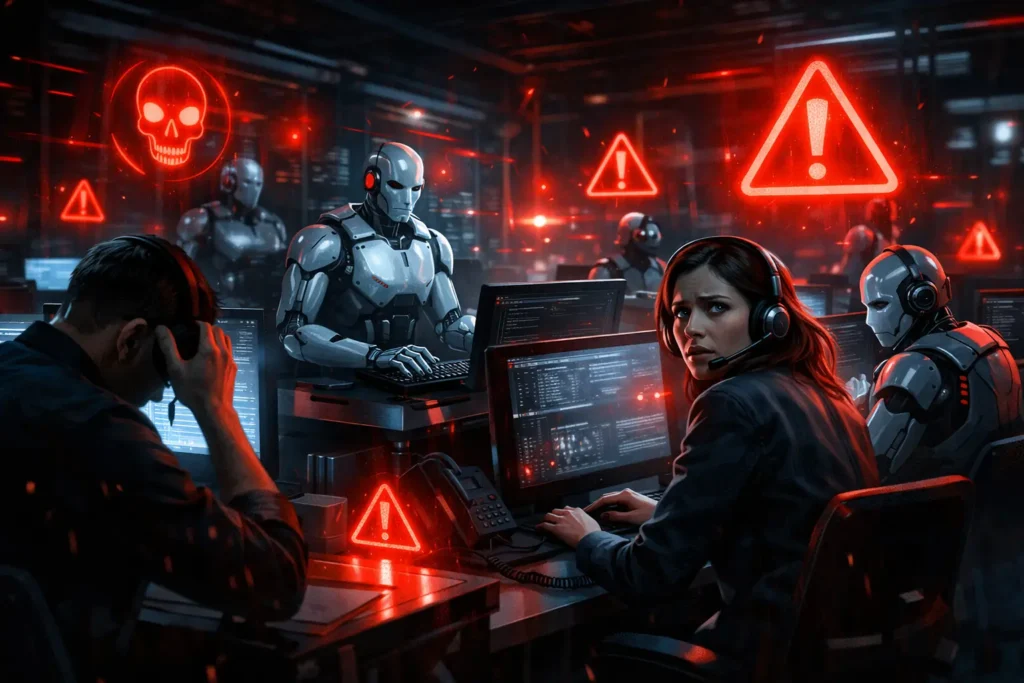
As artificial intelligence continues to grow, some professions face a much higher risk of automation. Experts studying Most AI-proof jobs 2026 often compare them with roles that AI systems can easily automate. These jobs usually involve repetitive digital tasks, predictable workflows, and limited human decision-making.
According to recent workforce studies, millions of jobs have already been automated, and more could be replaced in the next few years. Below are some of the highest-risk jobs for AI along with estimated automation impact.
1. Data Entry Clerk
AI Replacement Risk: Very High
Estimated Jobs Replaced/Affected: ~5 million globally
Data entry clerks are responsible for entering information into databases, spreadsheets, and digital systems. However, modern AI tools and automation software can process large amounts of data in seconds with fewer mistakes.
Why it’s risky:
This role involves repetitive tasks that follow simple rules. Because of this, it is often listed among the highest-risk jobs for AI, especially as companies adopt automated data management systems.
2. Telemarketer
AI Replacement Risk: Very High
Estimated Jobs Replaced/Affected: ~3 million globally
Telemarketing involves calling customers to promote products or services. Today, AI-powered voice systems and automated calling software can perform these tasks continuously without human workers.
Why it’s risky:
AI voice assistants can handle thousands of calls simultaneously and respond instantly to customer queries. This efficiency makes telemarketing one of the most highest-risk jobs for AI in the coming years.
3. Basic Customer Support Agent
AI Replacement Risk: High
Estimated Jobs Replaced/Affected: ~4 million globally
Customer service teams traditionally answer common questions about orders, payments, and product details. However, many companies now use AI chatbots to manage these interactions automatically.
Why it’s risky:
Most support questions follow predictable patterns that AI systems can handle easily. This makes basic customer support far more vulnerable compared to Most AI-proof jobs 2026 that require human interaction.
4. Bookkeeping and Basic Accounting
AI Replacement Risk: High
Estimated Jobs Replaced/Affected: ~2 million globally
Bookkeeping involves tracking financial records, organizing transactions, and preparing reports. AI-powered accounting software can now automatically categorize expenses and generate financial summaries.
Why it’s risky:
Since the tasks are structured and data-based, AI systems can process them faster and with fewer errors. As a result, bookkeeping is considered one of the highest-risk jobs for AI.
5. Basic Content Writing
AI Replacement Risk: Moderate to High
Estimated Jobs Replaced/Affected: ~1.5 million globally
Basic content writing includes simple articles, product descriptions, and marketing captions. AI writing tools can now generate this type of content quickly.
Why it’s risky:
Content that requires little creativity or research can easily be produced by AI. However, high-level storytelling, journalism, and strategy writing remain part of Most AI-proof jobs 2026.
Overall, the highest-risk jobs for AI are those that involve repetitive tasks and predictable processes. Careers that depend on human creativity, empathy, and complex problem-solving remain far safer in the AI era.
Most AI-Proof Jobs in 2026 List:
In Part 1, we explored why certain professions remain safe even as artificial intelligence becomes more powerful. The reality is that while AI can automate many digital tasks, it still struggles with jobs that require creativity, empathy, leadership, and physical skills. That is why students and professionals are now searching for Most AI-proof jobs 2026 when planning their future.
The next step is to understand which careers are truly secure in the long term. Many experts studying Jobs that AI cannot replace have identified several industries where human abilities remain essential. These careers often involve problem-solving in unpredictable environments or deep human interaction.
For students exploring Future-proof careers for students, this list can help guide better career decisions in the AI era.
10 Most AI-Proof Jobs List in 2026
Below is a list of some of the Most AI-proof jobs 2026 based on human skills, creativity, and real-world problem solving.
| Job Name | Core Skill | Average Salary |
|---|---|---|
| Electrician | Technical repair skills | $70,000 |
| Plumber | Hands-on problem solving | $65,000 |
| Mental Health Counselor | Empathy & communication | $75,000 |
| Nurse | Patient care | $90,000 |
| Surgeon | Medical expertise | $300,000 |
| Teacher | Human guidance | $60,000 |
| Civil Engineer | Infrastructure design | $95,000 |
| Psychologist | Behavior analysis | $100,000 |
| Social Worker | Community support | $55,000 |
| Creative Director | Creative strategy | $120,000 |
These careers remain among the Most AI-proof jobs 2026 because they require complex human judgment, real-world decision making, and emotional intelligence.
Beyond these 10 roles, there are many other professions that fall under Jobs that AI cannot replace.
Creative Arts Careers
Creative fields remain strong Future-proof careers for students because creativity and storytelling are deeply human abilities. While AI can generate images or text, it often lacks emotional depth and cultural understanding.
Jobs like film directors, musicians, designers, and writers depend on original ideas and artistic vision. Because creativity is difficult for machines to replicate, these roles are often listed among the Most AI-proof jobs 2026.
Teaching and Education
Education is another field where Jobs that AI cannot replace remain strong. Teachers do more than deliver information—they mentor students, inspire curiosity, and adapt lessons to different learning styles.
AI can help with grading or lesson planning, but the human connection between teacher and student cannot easily be replaced. This makes teaching one of the Future-proof careers for students.
Social Work and Community Services
Social workers support individuals and communities during difficult life situations. Their work often involves helping vulnerable groups such as children, elderly people, or families in crisis.
Because this work requires empathy and ethical judgment, it remains part of Most AI-proof jobs 2026. AI systems cannot replace genuine human care and understanding.
Civil Engineering and Infrastructure
Civil engineering is another important category among Jobs that AI cannot replace. Engineers design infrastructure such as bridges, roads, and water systems that require human decision-making.
Although AI tools assist with calculations, final decisions and safety planning still depend on human expertise. As cities continue to grow, civil engineering remains one of the Most AI-proof jobs 2026.
Global Trends Driving AI-Proof Jobs
Several global trends are increasing demand for Future-proof careers for students. One example is Sovereign AI, where governments develop their own AI systems for economic and security reasons.
Another trend is the Vibe Economy, where people value human experiences such as coaching, therapy, and creative services. Because of this shift, face-to-face professions are becoming more valuable and are widely considered Most AI-proof jobs 2026.
How Students Can Choose AI-Proof Careers
Choosing the right career is important in the AI era. Students who want stable jobs should focus on skills that machines cannot easily replace. Understanding Most AI-proof jobs 2026 can help students select Future-proof careers for students.
Step 1: Focus on Human Skills
Develop skills like communication, empathy, and leadership. These abilities are difficult for AI to copy and are important in many Jobs that AI cannot replace.
Step 2: Choose Hands-On Careers
Jobs that require physical work and real-world problem solving are safer from automation. Careers like electricians, plumbers, and mechanics remain part of Most AI-proof jobs 2026.

Step 3: Build Creative Thinking
Creative careers such as design, marketing, and media depend on original ideas. Creativity helps students build Future-proof careers for students even in the age of AI.
Step 4: Learn to Work With AI
Instead of avoiding technology, students should learn how to use AI tools. Combining human skills with AI knowledge can create stronger opportunities in modern careers.
FAQs AI-Proof Jobs
What are the most AI-proof jobs in 2026?
Some of the most secure careers include healthcare professionals, skilled trades, teachers, and creative professionals. These jobs require human judgment and interaction.
Why are some jobs safe from AI?
Jobs that involve emotional intelligence, creativity, and physical work are harder for machines to automate.
Are creative careers safe from AI?
Yes, many creative roles remain among Most AI-proof jobs 2026 because originality and storytelling depend heavily on human experience.
What skills protect careers from AI automation?
Critical thinking, leadership, communication, and empathy are considered essential Soft skills for the AI era.
Conclusion
Artificial intelligence will continue to transform the global workforce, but it will not eliminate the need for human talent. Instead, it will change the types of skills that employers value.
The Most AI-proof jobs 2026 are those that rely on creativity, empathy, leadership, and hands-on expertise. These careers highlight the strengths that make humans unique.
For readers of Choosfy.com, the best strategy is to focus on developing these human skills while learning how to work alongside technology. By combining human creativity with AI tools, the next generation can build Future-proof careers for students that remain valuable in the rapidly evolving digital world.
Choosfy.com is a growing platform where you can explore useful AI tools, and alsoFree Ai Tools, simple tech guides, and the latest AI updates. If you want to learn more about AI tools, just search Choosfy.com in Google. You can also check our free AI tools list and discover more helpful posts on our website.
Recommended Articles
- How to Add ChatGPT to WhatsApp in 2026: 3 Easy Methods
- Online Medical Coding and Billing Certification Programs 2026: Courses, Jobs, Salary & Career Guide
- Most People Use AI Tools Wrong — Try These 4 Simple Tricks Instead
- Free AI Tools List 2026: Best Free AI for Video, Image, and Productivity
- AI Tools for Students: Study Faster and Smarter in 2026
- Hidden AI Tools 2026: Powerful New AI Tools Most People Don’t Know
- Make Money with AI: Free AI Tools That Can Help You Earn Online
- How to Get Premium AI Features for Free in 2026
- How to Access Gemini AI Premium Features Free
- 10 Practical Problems ChatGPT Can Solve Better Than a Professional
- How to Use ChatGPT in 2026: Beginner to Advanced Guide
- AI Tools for Handwriting Notes Free in 2026
- AI Trip Planner India
- 20 Best Free AI Content Generator Tools in 2026
- Claude Code 2.0: The AI Coding Assistant Developers Are Switching To
- How to Use ChatGPT Voice Mode: The Ultimate 2026 Guide
I am Md Amon Sk, a Website Developer with 2 years of experience. As part of the Choosfy Team, I focus on building quality websites and sharing the latest insights on AI tools.
3 thoughts on “Ranked: Most AI-Proof Jobs in 2026: Careers That Machines Can’t Touch”
Comments are closed.